
An Ascle Legal Perspective
Review Petition- An Introduction
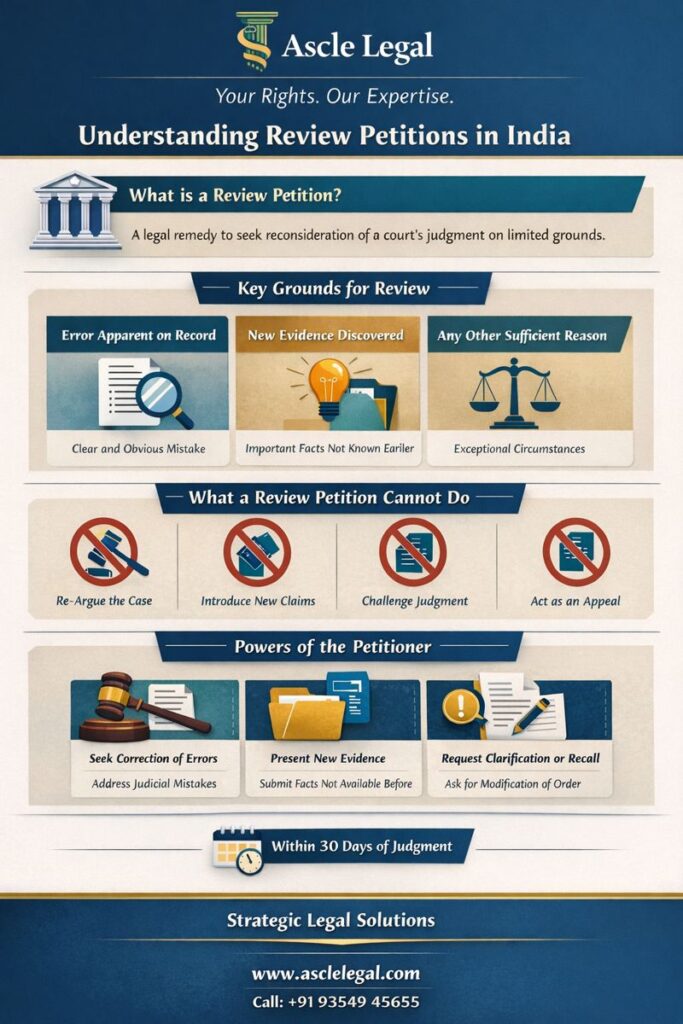
A Review Petition is a statutory remedy that allows a court to re-examine its own judgment or order to correct an apparent error. It is not an appeal but a limited judicial mechanism intended to prevent miscarriage of justice due to oversight, mistake, or error apparent on the face of the record.
A review is not an appeal. Its purpose is correction, not reconsideration of merits.
What Is a Review Petition?
A Review Petition is an application filed before the same court that delivered the judgment, seeking limited reconsideration on specific statutory grounds. Courts exercise this power with restraint to preserve the finality of judicial decisions.
The power of review is exercised by constitutional courts, including the Supreme Court of India and high courts, within well-defined legal boundaries.
Legal Foundation of Review Jurisdiction
The authority to entertain a review petition arises from:
- Article 137 of the Constitution of India
- Section 114 read with Order XLVII Rule 1 of the Code of Civil Procedure, 1908
These provisions balance judicial finality with corrective justice.
Essential Requirements of a Valid Review Petition
1. Error Apparent on the Face of the Record
The most recognised ground for review is an error that is clear, obvious, and self-evident. Such an error should not require extensive argument to establish.
Examples include:
- Misapplication of a statutory provision
- Ignoring binding precedent
- Clerical or arithmetical mistakes affecting the decision
2. Discovery of New and Material Evidence
A review may be considered where:
- The evidence was not within the petitioner’s knowledge earlier
- Despite due diligence, it could not be produced
- The evidence is material and directly impacts the judgment
Courts strictly scrutinise this ground to prevent misuse.
3. Any Other Sufficient Reason
This ground is interpreted narrowly and applies only to reasons analogous to error apparent or discovery of new evidence. Mere dissatisfaction with the judgment is insufficient.
What a Review Petition Is Not
At Ascle Legal, we advise clients that a review petition cannot be used for:
- Re-arguing the case on merits
- Introducing new legal strategies
- Challenging findings due to disagreement
- Seeking rehearing of concluded issues
A review is not an appeal in disguise.
Powers of the Petitioner in a Review Petition
Right to Seek Judicial Correction
The petitioner may bring apparent errors or omissions to the court’s attention where such errors have resulted in injustice.
Limited Right to Present New Evidence
The petitioner may rely on newly discovered evidence, subject to strict compliance with the requirement of due diligence.
Right to Seek Clarification, Modification, or Recall
In appropriate cases, the petitioner may seek:
- Clarification of ambiguous observations
- Correction of specific erroneous findings
- Recall of orders passed in violation of natural justice
Limited Right to Oral Hearing
Review petitions are generally decided in chambers. Oral hearings are granted only in exceptional circumstances involving grave injustice or substantial questions of law.
Procedural Discipline in Filing Review Petitions
- Must be filed within the prescribed limitation period
- Grounds must be precise and legally sustainable
- Drafting must reflect clarity and restraint
- Matters are generally placed before the same bench
Review Petition vs Appeal
| Review Petition | Appeal |
|---|---|
| Filed before the same court | Filed before a higher court |
| Limited statutory grounds | Broader scope |
| Correction of error | Re-examination on merits |
Conclusion
A Review Petition is an exceptional judicial remedy intended to correct patent errors and uphold fairness without undermining judicial finality. Courts exercise this power sparingly, and success depends on legal precision and genuine grounds.
Great content! Keep up the good work!
wild trucks game rules wild trucks game online