
Contract: Meaning, Essentials, Types, and Legal Importance
Introduction
A contract is the foundation of legal and commercial relationships. It governs everyday transactions—from simple agreements to complex business dealings—by defining rights, duties, and obligations of the parties involved. Contract law ensures certainty, fairness, and enforceability in agreements, making it one of the most vital branches of law.
In India, contracts are primarily governed by the Indian Contract Act, 1872, which lays down the principles relating to formation, performance, and enforcement of contracts.
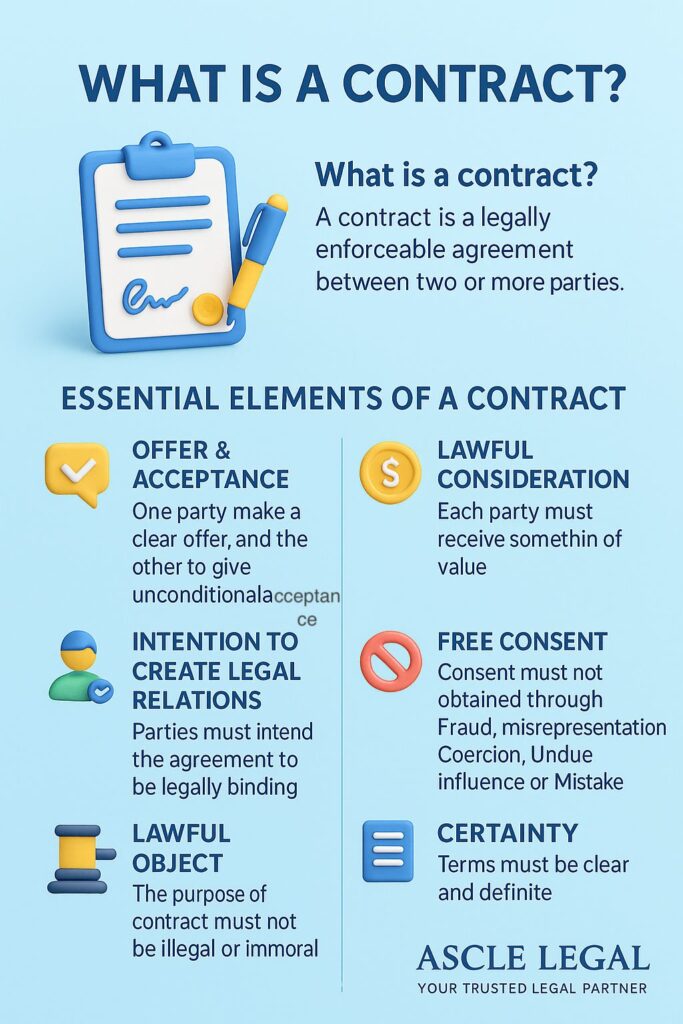
Meaning of Contract
According to Section 2(h) of the Indian Contract Act, 1872, “A contract is an agreement enforceable by law.”
Thus, not every agreement is a contract. Only those agreements that meet legal requirements and are enforceable by courts qualify as contracts.
Essential Elements of a Valid Contract
For an agreement to become a valid contract, the following essentials must be present:
1. Offer and Acceptance
One party must make a lawful offer, and the other must accept it unconditionally. Acceptance must correspond exactly with the terms of the offer.
2. Intention to Create Legal Relations
The parties must intend to enter into a legally binding relationship. Social or domestic agreements generally lack this intention and are not enforceable.
3. Lawful Consideration
Consideration refers to something of value exchanged between parties. It must be lawful, real, and not opposed to public policy.
4. Capacity of Parties
The parties must be legally competent to contract. Minors, persons of unsound mind, and persons disqualified by law cannot enter into valid contracts.
5. Free Consent
Consent must be free and not obtained by coercion, undue influence, fraud, misrepresentation, or mistake.
6. Lawful Object
The object or purpose of the contract must be lawful. Agreements involving illegal activities are void.
7. Certainty of Terms
The terms of the contract must be clear, certain, and not vague.
8. Possibility of Performance
The contract must be capable of being performed. Agreements that are impossible to perform are void.
Types of Contracts
1. Valid Contract
A contract that fulfils all legal requirements and is enforceable by law.
2. Void Contract
A contract that ceases to be enforceable by law due to certain circumstances, such as impossibility.
3. Voidable Contract
A contract that is enforceable at the option of one party, usually due to lack of free consent.
4. Executed and Executory Contracts
- Executed contract: Where obligations are fully performed.
- Executory contract: Where obligations are yet to be performed.
5. Express and Implied Contracts
- Express contract: Terms are clearly stated orally or in writing.
- Implied contract: Terms are inferred from conduct or circumstances.
6. Unilateral and Bilateral Contracts
- Unilateral: One party performs after the other has fulfilled their promise.
- Bilateral: Both parties exchange promises.
Performance of Contract
Performance refers to fulfilling contractual obligations. Parties must perform their promises unless performance is excused due to impossibility, frustration, or mutual agreement.
Breach of Contract
A breach occurs when a party fails to perform their contractual obligations. Breach may be:
- Actual breach (failure at the time of performance)
- Anticipatory breach (refusal before the due date)
Remedies for Breach of Contract
The Indian Contract Act provides several remedies:
- Damages – Monetary compensation for loss suffered
- Specific Performance – Court orders actual performance
- Injunction – Restrains a party from doing something
- Rescission – Cancellation of the contract
- Quantum Meruit – Payment for work done
Importance of Contracts
- Ensures legal certainty and predictability
- Protects rights and interests of parties
- Facilitates trade, commerce, and business
- Minimises disputes through clear obligations
- Provides legal remedies in case of breach
Conclusion
Contracts are the backbone of legal, commercial, and personal transactions. A well-drafted and legally sound contract not only prevents disputes but also strengthens trust between parties. Understanding the principles of contract law helps individuals and businesses safeguard their interests and conduct transactions with confidence and legal security.